
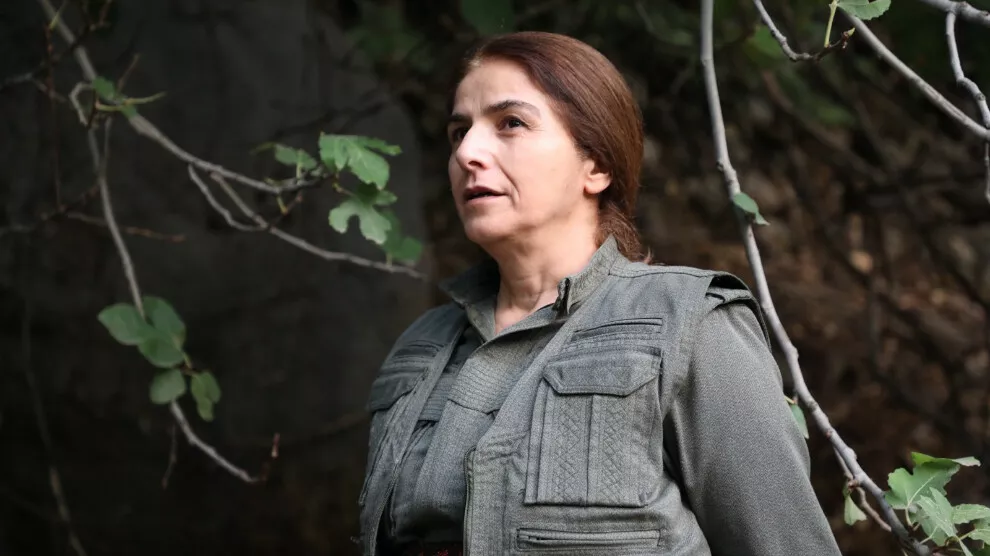
Cigdem Dogu: AKP’s Tactics Of Delay Pose A Serious Risk
Kurdistan Women's Communities (KJK) Executive Council member Cigdem Dogu appeared on a special program broadcast by Medya Haber television, where she discussed the Peace and Democratic Society Process initiated by Leader Apo (Abdullah Ocalan) and violence against women.
Cigdem Dogu emphasized that the Peace and Democratic Society Process cannot be reduced to disarmament alone, arguing that a democratic solution to the Kurdish question and the democratization of Turkey must be addressed together. She stressed the importance of recognizing Leader Apo’s role as coordinator of peace and political participation, saying that transparency, mutual dialogue and concrete steps are essential for building social support for peace.
Cigdem Dogu also called on women to take action ahead of November 25, the International Day for the Elimination of Violence against Women. She emphasized that violence against women cannot be explained as a series of isolated incidents but is produced by the male-dominated system. She stressed that women must go beyond resisting violence by building free lives, organizing themselves and developing self-defense mechanisms. Cigdem Dogu said that women must establish control over their lives in economic, social, cultural and physical spheres, calling for November to be dedicated to the struggle for women’s freedom under the slogan, “Now is the time for women, now is the time for women’s self-defense.”
Cigdem Dogu also discussed the youth movements emerging in different countries, describing them as expressions of significant social opposition to the existing political system. Citing the student movement in Serbia, she said that young people no longer accept the capitalist way of life or the existing order and have the potential to bring about profound change by joining forces with society.
Abdullah Ocalan took a step by initiating the Peace and Democratic Society Process and assumed full responsibility. However, the Turkish state has yet to take any concrete steps in response. There has been discussion in certain circles, but nothing tangible has emerged. Let me also mention that reports suggest Ocalan has been moved to a new location. Yet the Turkish state has made no official announcement concerning Ocalan’s coordinating role. Could you provide some information about this?
Before answering, I would like to mention that we have entered November, and the anniversary of November 27 is approaching. On this occasion, I congratulate Leader Apo on the anniversary of November 27 and extend my congratulations to our people. Throughout our history of struggle, we have lost thousands of martyrs and martyred comrades. Each of these martyrs played an enormously significant role in affirming the existence of the Kurdish people and opening the path toward freedom and a free life. They opened this path for us and showed us the way. On the occasion of November 27, I commemorate all our martyrs with love, respect and gratitude.
November 25 is also approaching. From the Mirabal sisters to Rosa Luxemburg, our comrades Sakine Cansiz (Sara) and Evin Goyi, and all the women comrades who were martyred throughout the years of war, these deaths and massacres resulted from attacks produced by the male-dominated system. There are also women murdered in social life as a result of this murderous, hierarchical system and the violent masculinity it produces. Hundreds of thousands, even millions of women have been killed. The struggle against this violence and the creation of a life in which women can live freely constitute a fundamental responsibility and obligation for our women’s struggle. I therefore commemorate all women who have been murdered.
Turning to your question, there is certainly a process underway, and it is being widely discussed. Some say that everything is progressing smoothly. We also assess the situation. In reality, the process is largely standing still. It is not progressing as smoothly as some claim. There are difficulties and steps that have not been taken. We can therefore speak of an existing process, but how effectively and healthily it is advancing remains highly questionable. From our movement’s perspective, it is a process that is not functioning or moving forward. It has not collapsed, but neither is it actively progressing.
Are they deliberately dragging out the process?
Yes, the process is being prolonged. But this delay poses a very serious danger. You asked about reports that Leader Apo has been moved to a new location. As far as we know, this is true. However, special warfare is also being conducted around this development. Umit Ozdag recently made a statement claiming that Leader Apo had actually been freed but that the Justice and Development Party (AKP) government was having difficulty announcing it. Of course, this is not the case. There is a new location, but it remains a continuation of imprisonment. It is not a situation in which Leader Apo has been freed and can move around freely. Leader Apo must be free within the framework of this process, able to work freely and live freely.
This is essential for the process to advance and reach a healthy conclusion. As a movement, this is our fundamental position. A process in which Leader Apo is not free, cannot work and cannot participate more actively and effectively has no conditions for progress. The objective conditions for advancement cannot be established under such circumstances. The political significance of moving to a new location must therefore be understood in this context. A committee has been established. Its formation was officially announced, although its name was changed and it was described as a disarmament committee. Leader Apo called it the Peace and Political Participation Committee. The central issue under discussion is Leader Apo’s role as the Coordinator of Peace and Political Participation within this committee.
The new location can only have meaning in this context, because Leader Apo fundamentally needs to be free. Its significance can only lie in enabling Leader Apo to work and participate actively as the committee’s coordinator. There is talk of the “law of fraternity” in this peace process. For the process to advance in a healthy manner, it is extremely important that Leader Apo be able to assume an official, publicly recognized and effective role within this committee. Leader Apo must be able to meet journalists, academics, politicians and other individuals who can contribute to the Peace and Democratic Society Process. There must be opportunities for discussion and dialogue. An environment must be created in which Leader Apo’s ideas, views, approach and strategy can reach the broadest possible sections of society and become widely understood. Yet none of these steps have been taken.
Would it not be better for Turkish society if Abdullah Ocalan could meet journalists, answer their questions and explain the paradigm of fraternity, allowing the democratic nation paradigm to become a reality for the peoples of Turkey and Kurdistan? Should the Turkish state not take more open and concrete steps?
Of course, it would be much better. As Leader Apo has repeatedly emphasized, we have experienced 50 years of struggle and a very difficult period of war. Naturally, mutual prejudices and fears have developed. This applies to both sides, to the Kurdish people and to the peoples of Turkey. There is therefore an urgent need to transform this atmosphere. How can that happen? We believe that the government’s and state’s approach must become much more visible and concrete. Creating such an atmosphere is important for building social support for peace. Fears must be overcome, we must get to know one another better, and relations must become more transparent. How much can the two sides communicate with each other? How effectively can they explain their concerns and circumstances? What is our strategy? What, for example, does a democratic republic strategy mean?
I sincerely believe that Leader Apo should be able to meet journalists and representatives of different sections of society. Leader Apo’s views should be freely and openly communicated throughout society. Leader Apo must be able to address the Turkish public. I believe that the peoples of Turkey will understand the Kurdish People’s Leader. They will understand what Leader Apo means and what a democratic republic represents. When we speak of a democratic nation, we are not seeking to divide Turkey. We do not want to partition this country. Yet this accusation has been attached to us. The definition of terrorism has largely been framed around allegations of separatism.
What harm could a democratic nation, a democratic republic or a democratic society cause anyone? What harm could they cause the peoples of Turkey, a woman, a man, a family or a young person living in Afyon, Edirne, Sinop, Antalya or any village or city in Turkey?
‘Peace will harm no one’
Not only would these ideas cause no harm, but they would also create an environment in which shared life, democratic coexistence and living together would strengthen Turkey and its peoples. Mutual prejudices and fears would gradually disappear, and the distance between communities would diminish. We believe this. That is why the move to a new location must be accompanied by these steps as a matter of urgency. There is no reason to fear democracy. Why should anyone fear peace? It is something worth seriously considering. Why would anyone be afraid of peace? There was a situation of conflict, and a period of war emerged from those circumstances. The Kurds were denied recognition. The struggle arose as a necessity to overcome that denial.
Leader Apo has explained this repeatedly and continues to do so. Yes, there was a war, and we have reached this point. Now is the time for peace. Now is the time for fraternity. Yet we continue to see approaches that resist this perspective, particularly in the media and among certain politicians. There is also fear within the ruling AKP government. The answer to why the process is not advancing must largely be sought here. There is fear. What would be lost if peace were achieved? What could the Turkish state possibly lose through peace? On the contrary, it would gain much more. There would be significant gains for the state economically and politically, as well as opportunities to develop a more democratic culture of coexistence and political life among the peoples.
For example, there is frequent talk of a “regional ownership strategy” or the “Turkey Century” vision. These are objectives that the AKP government has presented as part of its political vision. But how can a Turkish state that has not resolved the most fundamental problem within its own country develop a regional strategy? Is it possible to pursue a regional strategy based solely on security concerns and particular interests? To use their terminology, there is a “terrorism” problem, and the approach is simply to disarm those involved and consider the matter settled. This is an extremely superficial, narrow and dangerous approach. If you do not resolve a problem, it will continue to reappear, grow and eventually produce different consequences.
Are the contradictions within the AKP not also contributing to the growth of this problem? The AKP has been unable to resolve its own internal contradictions, and there has been a major financial scandal within the party.
There are certainly very serious problems produced by the war, both inside and outside the AKP. Under the banners of nationalism, patriotism and declarations of love for the homeland, countless massacres have been committed. That is one dimension. Another dimension is the creation of enormous opportunities for profiteering. We see companies operating within the state, the government and political structures. The alliances and relationships between political actors and companies have created extensive opportunities for profit. How did this happen? If there had been genuine peace, healthy state administration and effective oversight mechanisms, would such enormous opportunities for profiteering have emerged? A political environment has developed in which even the little bread remaining in the hands of the people is taken away and stolen. We cannot consider this independently of the war. Of course, this is also a characteristic of the capitalist system itself. But the system has become even more corrupt as capital has used the war to expand its opportunities for profit.
There is no oversight within the state or government institutions. Nobody supervises anybody else. Such oversight does not serve their interests, and nobody holds them accountable. The institutions responsible for oversight should be investigating these matters. But the judiciary and many other state institutions have become paralyzed, producing serious consequences. The situation within the AKP reflects this reality. Similar consequences are emerging in different sectors. If there were peace, if the Kurdish people and the peoples of Turkey could come together within a democratic political environment, and if this atmosphere of hostility and the politics built upon it disappeared, corruption, profiteering and moral decay could certainly be prevented.
Why am I saying all this? Because we are currently in such a process, and problems are erupting. Imagine a person with an infected wound. You say, “I will heal this wound.” You open it, but you neither operate on it nor treat it. The wound remains open, becomes exposed to more germs and grows increasingly infected.
That is the situation we face. There are unhealthy approaches within the opposition, and there are problems emerging within the AKP. Rather than adopting the superficial approach of disarmament, we must carry out a proper, radical operation by democratizing the system and identifying the problem for what it is. This is the Kurdish question. It is a question of democratization, of Turkey’s democratization. We must name it and undertake this operation together. The result would be a healthier and more democratic Turkey. Leader Apo has a historic role to play here. Nobody should portray Leader Apo as an enemy. Nobody should approach Leader Apo through special warfare or hostile characterizations. The Kurdish question does not concern Turkey alone. It is a multilayered issue.
‘Democracy will benefit everyone’
The Kurdish question concerns Rojava and Syria. It concerns Başûr (Southern Kurdistan) and Iraq. It directly concerns Rojhilat (Eastern Kurdistan) and Iran. It has a very broad sphere of influence and involves multiple dimensions. The continued refusal to recognize Leader Apo’s role and mission in resolving such a complex, multilayered question, attempts to trivialize that role or even portray Leader Apo as an enemy, are profoundly misguided. Such an approach carries the danger of losing a historic opportunity. Everyone must therefore recognize Leader Apo’s role as Coordinator of Peace and Political Participation. This role must be acknowledged as an open, official and legitimate reality. Such recognition would also contribute to genuine normalization. I believe that everyone who understands and becomes familiar with Leader Apo’s views will agree with this. It is therefore important to open the way for the process in this manner. Steps must be accelerated. The healthiest approach is not simply to say that the process is progressing well, but to advance it through concrete action.
Democracy will benefit everyone. Peace will benefit everyone. There should be no fear of democracy, peace or a solution. If a new republic is to emerge, it will be through overcoming our fears. The opposition should not fear this. Neither should ordinary people, workers or laborers. It is possible to develop such a process together. But as I have said, we can achieve this only by overcoming our fears and expanding the areas in which we come together. Leader Apo’s role is extremely important in this respect.
We hope the state overcomes its fears. I do not believe that workers or Turkish society are afraid.
Special warfare creates precisely that perception!